
[20260504] Why European-Standard Firefighting Gear Better Meets the Needs of Asia | KANOX® Fire Safety Fabrics: Durable and Certified Fire-Resistant Solutions
Across many Asian countries, firefighting gear procurement is commonly based on the EN 469 standard. While this is partly due to regulatory history, the more compelling reason lies in its strong alignment with real-world environments and climate conditions in Asia.From intense radiant heat in dense urban structures to hot and humid weather, European standards offer a scientifically grounded approach that matches the operational demands faced by firefighters across the region.1️⃣ Protection Against Different Heat Sources Fireground hazards are rarely uniform. Firefighters may encounter: 💣 Direct flame contact in confined spaces 💣 Intense radiant heat from structures such as metal-roof buildingsEN 469 addresses this complexity by clearly separating thermal protection into two performance indicators: 🔴 Xf (Flame Heat Transfer): Measures protection against direct flame exposure 🔴 Xr (Radiant Heat Transfer): Measures resistance to radiant heatThis dual-testing approach ensures that firefighting gear can deliver high-level protection (Level 2) across different fire scenarios—whether facing direct flames or prolonged radiant heat exposure.2️⃣ Ergonomic Design for Mobility and Performance Firefighting is physically demanding, requiring constant movement—climbing, bending, reaching, and crawling in unpredictable environments. EN standards include mandatory ergonomic assessments, ensuring that garments do not restrict essential movements such as: ➡︎ Raising arms ➡︎ Bending at the waist ➡︎ Donning and doffing gear efficiently Building on these requirements, SUPER ARMOR further enhances mobility by: ♥️ Expanding articulation zones around joints ♥️ Optimizing garment proportions based on Asian body types The result is gear that remains flexible, responsive, and non-restrictive, even during high-intensity operations.3️⃣ Breathability: A Critical Factor in Hot and Humid Climates One of the most critical challenges for firefighters in regions like Taiwan is heat stress caused by humidity and intense physical exertion. This is where Section 6.3.1 🖍️Water Vapour Resistance🖍️ in EN 469 becomes especially important. This section evaluates how easily sweat vapor can escape through the garment, providing a measurable indicator of breathability. EN 469 classifies moisture vapor performance into levels (such as Z1 and Z2), allowing users to clearly identify whether their gear meets higher breathability standards.📂 Why This Matters for Firefighters 👀 Heat Stress Management If moisture cannot escape, heat becomes trapped inside the suit, raising core body temperature and increasing the risk of heat exhaustion or heat stroke. Lower water vapour resistance (e.g., Z2 level) helps the body cool more effectively. 👀 Sustained Operational Performance Efficient moisture management reduces fatigue, helping firefighters maintain endurance, focus, and decision-making ability during prolonged operations. 👀 Balanced Protection Section 6.3.1 ensures that garments are not only thermally protective but also breathable—achieving the right balance between external heat resistance and internal heat dissipation.In hot and humid environments, this is not just about comfort — it is essential for operational safety and performance.◁ The Right Gear for the Right Environment ▷ When it comes to protective equipment, there is no absolute “best” — only what is most suitable for the environment and mission. European-standard firefighting gear, with its balanced focus on thermal protection, mobility, and breathability, provides a well-rounded solution that aligns closely with the challenges faced by firefighters across Asia. Because in the field, the right gear doesn’t just protect—it empowers performance when it matters most. KANOX® FR Fabrics / SUPER ARMOR® Turnout Gears is an ISO 9001, NFPA, and EN certified fire fighting garment, protective clothing, fire retardant fabric, fire resistant clothing, flame retardant fabric, fire retardant clothing manufacturer from Taiwan since 1976. Founded in 1976 and based in Taiwan, KANOX® is a global leader in fire-resistant fabrics and protective clothing. Renowned for innovation and durability, KANOX® offers a wide range of certified fire-retardant solutions meeting international standards like ISO 9001, NFPA, and EN. Our advanced technology and over 40 years of expertise ensure top-quality products designed to safeguard lives in the most hazardous environments. Trusted worldwide, KANOX® sets the benchmark for excellence in fire safety.
[20260504] Why European-Standard Firefighting Gear Better Meets the Needs of Asia
Across many Asian countries, firefighting gear procurement is commonly based on the EN 469 standard. While this is partly due to regulatory history, the more compelling reason lies in its strong alignment with real-world environments and climate conditions in Asia.
From intense radiant heat in dense urban structures to hot and humid weather, European standards offer a scientifically grounded approach that matches the operational demands faced by firefighters across the region.
1️⃣ Protection Against Different Heat Sources
Fireground hazards are rarely uniform. Firefighters may encounter:
💣 Direct flame contact in confined spaces
💣 Intense radiant heat from structures such as metal-roof buildings
EN 469 addresses this complexity by clearly separating thermal protection into two performance indicators:
🔴 Xf (Flame Heat Transfer): Measures protection against direct flame exposure
🔴 Xr (Radiant Heat Transfer): Measures resistance to radiant heat
This dual-testing approach ensures that firefighting gear can deliver high-level protection (Level 2) across different fire scenarios—whether facing direct
flames or prolonged radiant heat exposure.
2️⃣ Ergonomic Design for Mobility and Performance
Firefighting is physically demanding, requiring constant movement—climbing, bending, reaching, and crawling in unpredictable environments.
EN standards include mandatory ergonomic assessments, ensuring that garments do not restrict essential movements such as:
➡︎ Raising arms
➡︎ Bending at the waist
➡︎ Donning and doffing gear efficiently
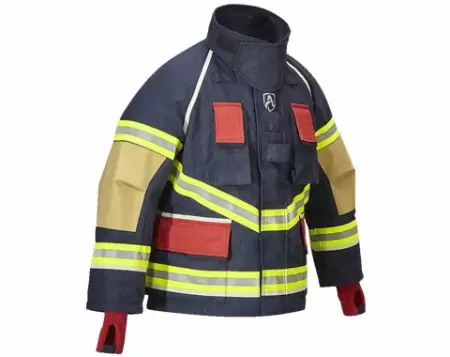
Building on these requirements, SUPER ARMOR further enhances mobility by:
♥️ Expanding articulation zones around joints
♥️ Optimizing garment proportions based on Asian body types
The result is gear that remains flexible, responsive, and non-restrictive, even during high-intensity operations.
3️⃣ Breathability: A Critical Factor in Hot and Humid Climates
One of the most critical challenges for firefighters in regions like Taiwan is heat stress caused by humidity and intense physical exertion.
This is where Section 6.3.1 🖍️Water Vapour Resistance🖍️ in EN 469 becomes especially important. This section evaluates how easily sweat vapor can
escape through the garment, providing a measurable indicator of breathability.
EN 469 classifies moisture vapor performance into levels (such as Z1 and Z2), allowing users to clearly identify whether their gear meets higher
breathability standards.
📂 Why This Matters for Firefighters
👀 Heat Stress Management
If moisture cannot escape, heat becomes trapped inside the suit, raising core body temperature and increasing the risk of heat exhaustion or
heat stroke. Lower water vapour resistance (e.g., Z2 level) helps the body cool more effectively.
👀 Sustained Operational Performance
Efficient moisture management reduces fatigue, helping firefighters maintain endurance, focus, and decision-making ability during prolonged operations.
👀 Balanced Protection
Section 6.3.1 ensures that garments are not only thermally protective but also breathable—achieving the right balance between external
heat resistance and internal heat dissipation.
In hot and humid environments, this is not just about comfort — it is essential for operational safety and performance.
◁ The Right Gear for the Right Environment ▷
When it comes to protective equipment, there is no absolute “best” — only what is most suitable for the environment and mission.
European-standard firefighting gear, with its balanced focus on thermal protection, mobility, and breathability, provides a well-rounded solution that aligns closely with the challenges faced by firefighters across Asia.
Because in the field, the right gear doesn’t just protect—it empowers performance when it matters most.
Relative Links : EN 469 Test Methods SUPER ARMOR Turnout Gears Moisture Barrier
To be a global performance leader for firefighting suits and inherently fire resistant fabrics.
[20260504] Why European-Standard Firefighting Gear Better Meets the Needs of Asia | Explore KANOX® Fire Safety Apparel: Advanced Fire-Resistant Clothing
Established in 1976, Taiwan K.K. Corporation is headquartered in Taiwan and excels in developing and producing top-tier fire retardant fabrics. Our flagship products, the KANOX® and GORNOX series, are highly esteemed for their superior protection and durability in industrial and safety applications. Committed to innovation and stringent quality standards, KANOX® delivers reliable fire-resistant materials that meet the rigorous demands of various industries, ensuring maximum safety and performance through state-of-the-art manufacturing and comprehensive quality control processes.
KANOX® products are engineered for exceptional durability, enduring the toughest conditions while ensuring optimal performance. Our fire retardant fabrics meet and exceed international safety standards, holding certifications such as ISO 9001, NFPA, and EN. This rigorous certification process guarantees that our fabrics provide reliable, long-lasting protection in critical applications. Our commitment to quality and adherence to stringent certification standards highlight KANOX® as a global leader in fire-resistant materials, trusted for safety and reliability.
With over 48 years of experience and advanced technology, KANOX® FR Fabrics / SUPER ARMOR® Turnout Gears offers top-quality protective fire-resistant clothing for firefighters, ensuring each customer's needs are met.